
When a loved one is living with dementia, wandering can become one of the most stressful safety concerns a family faces. A person may leave the house during a familiar routine, get turned around on a walk, or head toward a place that makes sense in their memory but is no longer safe. The risk is real and well-documented.
The Alzheimer's Association states that 6 in 10 people living with dementia will wander at least once, and many do so repeatedly — and that it can happen at any stage of the disease. Source: alz.org
That is why so many families start looking for dementia wandering devices. The best device is not necessarily the most advanced one. It is the one that fits the actual situation, gives caregivers useful response time, and helps reduce the chance that confusion turns into injury or a missing-person emergency.
What Are Dementia Wandering Devices?
Dementia wandering devices are tools designed to alert caregivers when someone is moving into an unsafe situation, or to help locate them if they have already wandered. Some are built for the home — door alarms, room monitors, motion sensors. Others are wearable, such as GPS-enabled watches, emergency alert buttons, and location-capable safety devices.
The National Institute on Aging recommends practical home safeguards such as alarms that chime when a door opens, and also includes GPS tracking systems among the personal safety devices families should consider for someone living with early-stage dementia. Source: nia.nih.gov
1. Door Alarms
Door alarms are often the simplest and most effective starting point. They alert a caregiver when an exterior door is opened — giving a chance to respond before someone gets far from home.
This type of device makes most sense when the main concern is unexpected exiting, especially at night or during periods of confusion.
Both the Alzheimer’s Association and the National Institute on Aging recommend door alarms and warning devices as part of a wandering prevention setup
Best for: Families who need immediate awareness at the point of exit. Main limitation: tells you someone has left, but not where they went.
2. Room Monitors
Room monitors help caregivers hear movement, distress, or overnight activity — useful when the concern starts inside the home rather than at the front door.
The National Institute on Aging notes that a room monitoring device can help alert a caregiver to sounds indicating a fall or other nighttime need. This type of monitor improves awareness but does not provide location tracking.
Best for: Nighttime supervision when the concern is inside-the-home activity. Not a wandering-recovery device — improves early awareness, not location tracking.
3. Bed and Chair Exit Alarms
Bed and chair alarms are designed to notify a caregiver when a person gets up unexpectedly. They are especially useful for nighttime wandering risk, fall risk, or situations where someone should not be walking without assistance.
Their advantage is the early response window they create — before the person has reached a hallway, door, or outdoor area. Their limitation is that they provide no information once the person has already left the immediate area.
Best for: Catching the very first movement — nighttime exiting, overnight fall risk, or situations where the person should not walk alone.
4. Motion Sensors
Motion sensors help monitor movement in hallways, near stairs, or around entry points. They are most useful as part of a layered setup rather than as a standalone solution.
This type of device works particularly well when wandering tends to follow a consistent pattern — getting out of bed, moving through a hallway, and approaching an exit. Tracking that path creates an earlier intervention window than a door alarm alone.
Best for: Families who want broader indoor awareness across multiple areas without placing a monitor in every room.
5. GPS Tracking Devices
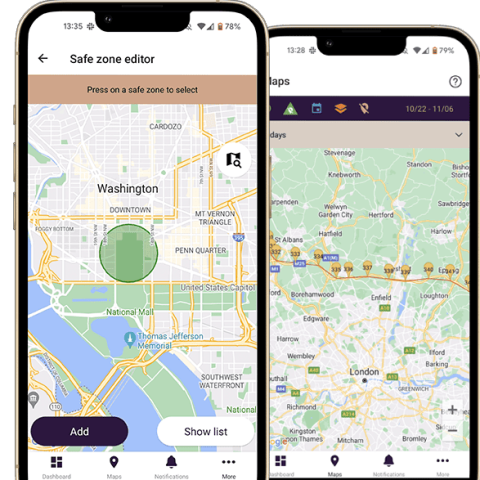
GPS devices are among the most useful wandering tools when the risk extends beyond the home. They help caregivers locate a loved one after they have already wandered — which makes them fundamentally different from door alarms or bed alerts. Their value is in recovery and location awareness, not in preventing the first movement.
The National Institute on Aging specifically includes GPS tracking systems among the personal safety devices families should consider for someone living alone with early-stage dementia. Source: nia.nih.gov
GPS devices are strongest when the person still walks independently, spends time outside, or does not stay within a single controlled environment.
The Tranquil GPS Watch is a GPS wearable designed specifically for seniors with dementia. It provides 24/7 real-time location tracking through a companion app, and also sends an instant alert the moment the wearer leaves home via a Bluetooth home-exit beacon — so caregivers get both an early warning and live location in a single device. It includes an SOS button that escalates through up to eight contacts, two-way calling with auto-answer so caregivers can reach the wearer without them needing to answer, a tamper-proof locking strap, IP67 waterproofing, and up to a full week of battery life.
Best for: Loved ones who still walk independently or spend time outdoors, and situations where knowing where someone is matters as much as the initial alert.
6. Emergency Call Buttons
Emergency alert devices can be useful when a person still understands how and when to press for help. They support faster response during confusion, distress, or getting lost — but only when the wearer can recognize the situation and remember to act.
These work best in earlier stages or when the person can still communicate reliably. The practical limitation is significant: a button only helps if the person remembers to use it and is physically able to do so.
Best for: Early-stage dementia where the person can still recognize an emergency and reliably initiate a call for help.
7. Wearable Wandering Devices
Wearable devices combine the most important features into one category. Depending on the product, they can include real-time GPS tracking, caregiver alerts, two-way communication, safe-zone monitoring, and a tamper-resistant design that keeps the device on even when the wearer resists.
For many families, this becomes the most practical long-term option — because it moves with the person instead of depending on a single room, doorway, or bed sensor.
Wearables are especially useful when wandering happens outside the home, when caregivers need more than a single alert point, or when a family wants a more complete safety tool rather than several separate devices.
The Tranquil Watch is designed to look like a traditional dress watch — not a medical device — which means most wearers accept it without resistance. It is available in four elegant colorways with leather or silicone strap options, and comes with a free tamper-proof locking strap that can only be removed with a special tool. It is IP67 waterproof, so it stays on through showers and daily activities. Battery life lasts up to a full week, significantly reducing the risk of the device being off during a critical moment. Every purchase includes a 30-day risk-free trial with free return shipping.
Best for: Families who want one device that covers GPS tracking, caregiver alerts, two-way communication, and consistent all-day wear — especially when outdoor wandering is a concern.
Which Wandering Device Is Best?
The answer depends on the real risk.
If the main concern is someone leaving the house unexpectedly, a door alarm is often the best starting point. If the main concern is nighttime wandering inside the home, room monitors or bed-exit alarms may be more useful. If the person is still mobile and may get lost outside, a GPS-enabled wearable is usually the stronger option.
Both the National Institute on Aging and the Alzheimer’s Association frame wandering safety as something that requires planning, layered safeguards, and quick response — not a single device.
What Families Should Look For
A good wandering device should match the way wandering actually happens in the home. That means asking a few practical questions before comparing products:
- Does wandering happen mostly at night, during the day, or both?
- Does it tend to start at the bedroom, the hallway, or the front door?
- Is the bigger concern preventing an exit, or locating someone after they have left?
- Will the person tolerate a wearable device day to day?
- Can the caregiver respond quickly when an alert fires?
A simple device that fits the real risk is usually better than a more advanced one that does not match the actual situation.
Why Layered Protection Works Best
Families often look for one device that solves wandering completely. In practice, layered protection is usually stronger.
A bed alarm may catch the first movement. A hallway motion sensor may confirm the direction. A door alarm may warn of an exit. A wearable GPS may help if the person gets beyond the home and cannot find their way back.
That layered approach is consistent with broader patient-safety thinking. AHRQ’s PSNet patient safety guidance describes patients who wander as “requiring a high degree of monitoring and protection to ensure safety,” particularly when cognitive impairment limits judgment and awareness.
Final Thoughts
The best dementia wandering devices are the ones that create useful response time. For some families, that starts with a door alarm. For others, it means adding room monitoring, bed alerts, motion sensors, or a GPS-enabled wearable for outdoor coverage.
What matters most is not having the most devices. It is choosing the right device for the actual behavior, the actual environment, and the actual response needs of the people providing care.
For families where outdoor wandering is a concern — or who want a single device that covers tracking, alerts, and direct communication — the Tranquil GPS Watch is purpose-built for exactly that situation. Every purchase includes a 30-day risk-free trial with free return shipping, and a support team available seven days a week.
