
When a patient is at risk of wandering, the goal is not simply to know that they have left a room or building. The goal is to know quickly, respond quickly, and reduce the chance that confusion turns into injury, exposure, or a full missing-person event.
That is why patient wandering alert systems matter in homes, care facilities, hospitals, and memory care settings. Wandering is common in dementia.
The Alzheimer's Association states that 6 in 10 people living with dementia will wander at least once, and many do so repeatedly — noting that wandering can happen at any stage of the disease and can become dangerous or life-threatening. Source: alz.org
For care teams and families, the best patient wandering alert system is the one that matches the actual risk. In some settings, that means a simple door alarm. In others, it means a broader layered setup that combines exit monitoring, staff alerts, and wearable location tracking.
What Is a Patient Wandering Alert System?
A patient wandering alert system is any device or monitoring setup designed to notify caregivers or staff when a person at risk has moved into an unsafe area, left a safe area, or may require immediate follow-up.
These systems are commonly used for:
- Patients with dementia or Alzheimer’s disease
- Memory care residents in assisted living or nursing facilities
- Hospital patients with cognitive impairment or delirium
- Rehab patients experiencing confusion after illness or injury
- Older adults at home who may leave a room or building without understanding the risk
Wandering vs. Elopement: What’s the Difference?
It is worth knowing the distinction between wandering and elopement, since different settings and care contexts use these terms differently.
Wandering: A cognitively impaired patient who strays beyond the view or control of staff without the intent of leaving.
Elopement: A patient who is aware they are not permitted to leave, but does so with intent.
This distinction is drawn from AHRQ’s PSNet patient safety guidance. Source: psnet.ahrq.gov
In practice, the line between the two can blur — capacity can shift within a single day. The more important point for care teams and families is this: both situations create real safety risk, and both call for early detection rather than after-the-fact response.
Why Wandering Alert Systems Matter
Wandering creates a real safety problem because time matters. A delayed response can mean a patient reaches a roadway, stairwell, parking lot, or unfamiliar outdoor area before anyone realizes they are gone.
AHRQ’s patient safety material describes patients who wander as “requiring a high degree of monitoring and protection to ensure the patient’s safety.” Source: psnet.ahrq.gov
In hospital and facility settings, wandering also creates operational and liability risk. That is why alert systems are increasingly treated not as optional add-ons but as a standard part of safety planning for at-risk patients.
For families caring for someone at home, the risk is just as real — but usually looks different. A person who leaves the front door unexpectedly, becomes disoriented outside, or cannot find their way home needs the caregiver to know fast.
Main Types of Patient Wandering Alert Systems
1. Door Alarms and Exit Alerts
Door alarms are often the simplest and most practical starting point. They alert a caregiver or staff member when a patient opens a door, approaches an exit, or leaves a room or unit.
These systems are especially useful for home entrances and back doors, memory care unit exits, overnight monitoring, and patients who repeatedly try to leave during periods of confusion.
The National Institute on Aging recommends door alarms and warning bells as part of a wandering prevention setup for people with dementia.
Best fit: Families at home, smaller care homes, and units where the main risk is unsupervised exiting.
2. Bed and Chair Exit Alarms
Bed and chair alarms alert staff or caregivers when a patient gets up unexpectedly. These are often used when wandering risk is tied to nighttime activity, fall risk, or confusion after waking.
They do not track the person once they have moved, but they give caregivers an early warning and a head start. That makes them most useful in higher-supervision settings where an immediate response is realistic.
Best fit: Hospitals, rehab settings, memory care rooms, and home care situations where the primary risk begins the moment the patient gets up alone.
3. Motion Sensors and Hallway Monitoring
Motion sensors help monitor movement patterns in rooms, hallways, or designated zones. These systems are useful when staff need to know that someone is moving toward an exit or into an unsafe area without relying on direct observation at all times.
Motion monitoring is most effective as part of a layered system rather than as a standalone solution — it adds visibility in the area between a patient’s room and the exit, which is where early intervention is most useful.
Best fit: Care homes, senior living settings, and larger homes where wandering may begin inside the building before reaching an exit.
4. Wearable Wandering Alert Devices

Wearable alert devices are often the strongest option when a patient is mobile and may wander beyond a room, unit, or home. These devices move with the person, giving caregivers visibility that fixed sensors and door alarms cannot provide once the person has moved on.
This category becomes more important when the patient still walks independently, the environment is larger, the person may leave the building, or caregivers need a faster way to locate someone after they have already moved.
For families caring for a loved one at home, a wearable designed for seniors with dementia can also support two-way communication, tamper-resistant wear, and location tracking all in one device — which is more practical than combining multiple separate tools.
The Tranquil GPS Watch is built specifically for seniors with dementia and age-related cognitive decline. It includes 24/7 real-time GPS tracking, a Bluetooth home-exit beacon that sends an instant alert when the wearer leaves home, customizable safe-zone alerts, an SOS button that escalates through up to eight contacts, two-way calling with auto-answer, a tamper-proof locking strap, IP67 waterproofing, and up to a full week of battery life. It is designed to look like a traditional dress watch — not a clinical device — so most wearers accept it without resistance.
Best fit: Memory care, assisted living, families at home, and any situation where the person is mobile and may move beyond a fixed monitored zone.
5. GPS-Based Wandering Alert Systems
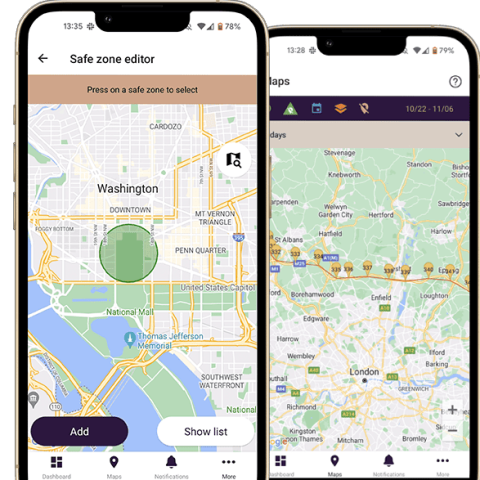
GPS-based systems are usually the best fit once the risk extends beyond a single building. Unlike fixed alarms, these systems allow caregivers to locate someone after they have already left a safe area — not just know that they left.
For families, this is often the most practical option when a loved one still goes outside, walks independently, or cannot reliably carry or answer a phone. For care facilities, GPS-based monitoring is most useful for specific higher-risk individuals rather than as the only layer of protection across an entire unit.
For home-based use, the Tranquil Watch provides both the early-warning home-exit beacon and real-time GPS location recovery in one device — covering both the first alert and the location follow-up that matters when a loved one has already left. Every purchase includes a 30-day risk-free trial and free shipping across the US.
Best fit: Outdoor wandering risk, community-based care, and situations where location recovery matters as much as the first alert.
What Features Matter Most?
The best patient wandering alert system is not the one with the longest feature list. It is the one that fits the real care environment and provides the fastest usable response.
Fast, Clear Alerts
If the alert is too quiet, too delayed, or too easy to miss, the system loses its value. Staff and caregivers should know immediately when a patient has moved into a risk situation. Alerts delivered by phone call, app notification, or audible chime all have different advantages depending on the setting.
Coverage That Matches the Setting
A home may need front-door and back-door exit alerts. A care home may need hallway, exit, and room-level monitoring. A hospital may need bed-exit alerts plus unit-exit awareness. The system should match the actual route a patient is likely to take — not the widest possible coverage area.
Ease of Response
An alert only helps if someone can act on it quickly. Notifications should be understandable, clearly actionable, and sent to the right person or team. A system that sends alerts to a shared inbox, requires multiple steps to respond, or produces false alarms regularly will eventually be ignored.
Wearability and Compliance
For wearable systems, the patient has to keep the device on. A device that is uncomfortable, confusing, or easy to remove may not hold up in real-world care. Tamper-resistant designs and familiar form factors — like a standard watch — tend to perform better than pendants or bracelets that feel medical or unfamiliar.
Location Recovery After Exit
Fixed alarms can tell staff that someone has left. They cannot tell staff where that person went. In higher-risk cases, a location-enabled system changes the response from “search the building” to “go to this address” — which can significantly reduce response time and harm.
Reliability
Battery life, signal stability, and consistent daily functioning matter more than extra features. An alert system that fails intermittently is worse than a simpler one that always works. For wearable devices in particular, a device with week-long battery life creates far fewer gaps in coverage than one that needs daily charging.
Which Wandering Alert System Is Best?
The right answer depends on the setting and the specific risk.
For families at home, the best starting point is often a door alarm or exit sensor if the main concern is leaving the house unexpectedly — combined with a wearable GPS device if the person also goes outside regularly. The National Institute on Aging supports door-alarm setups as part of home wandering prevention.
For care homes and memory care settings, a layered approach works best. Bed or chair exit alerts catch the first movement. Hallway or door monitoring catches route progression. Wearable or GPS tools support faster location recovery if the resident moves beyond the unit.
For hospitals, the highest priority is usually immediate staff notification and fast intervention. AHRQ’s patient safety guidance makes clear that patients who wander require close monitoring and protection, particularly when cognitive impairment limits safe decision-making.
How Families and Facilities Should Evaluate a System
Before choosing a wandering alert system, a few direct questions usually narrow the decision faster than comparing brand features:
- Is the main concern nighttime exiting, daytime wandering, or both?
- Does the patient stay inside one building, or are they likely to get outside?
- Is this for one person at home, or many residents in a facility?
- Can staff or caregivers respond immediately when an alert fires?
- Would a fixed alarm be enough, or is real-time location tracking needed too?
- Is the patient likely to remove a wearable device?
These questions tend to reveal the right product category faster than any feature comparison.
A Practical Buying Approach
Start with the highest-risk scenario first. If the patient is leaving through exterior doors, solve that first. If the patient is getting up at night and wandering into hallways, start there. If the patient has already wandered beyond the home or facility perimeter, location-enabled monitoring becomes the more important priority.
For many families and facilities, the most effective long-term setup is layered: an early alert at the point of movement, an exit alert at the point of leaving, and a way to recover location if the person gets beyond the immediate area.
That approach is more practical than expecting one device to solve every form of wandering — and more honest about what different types of products actually do well.
Final Thoughts
The best patient wandering alert systems do not just create noise. They create usable response time.
For some homes, a simple door alarm is enough. For some hospitals, bed and exit alerts are the right fit. For care homes and higher-risk dementia situations, a layered setup is often stronger — because it helps catch wandering early and supports faster action if the patient moves beyond a safe zone.
What matters most is choosing a system that fits the real risk, the care environment, and the response capacity of the people responsible for safety.
For families managing wandering risk at home, the Tranquil GPS Watch combines early home-exit detection with real-time GPS tracking, tamper-resistant wear, and two-way communication in a single wearable designed specifically for seniors with dementia. Every purchase includes a 30-day risk-free trial with free return shipping.
